
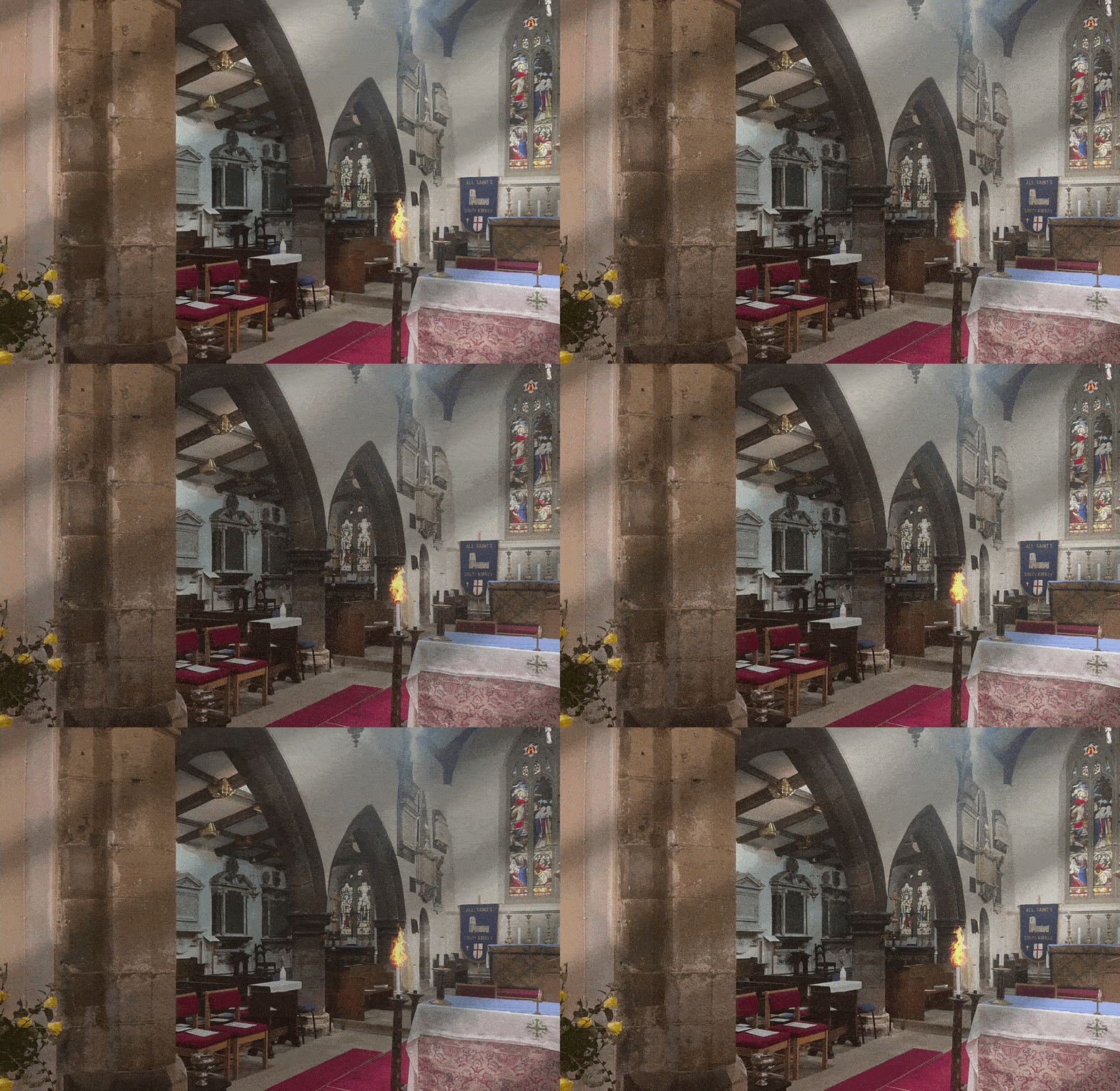
South Kirkby’s All Saints church is the focal point of the area, with its tower dominating what was the centre of the old medieval village. The name South Kirkby is of Scandinavian origin, the Old Norse kirkja (church) and bý (farmstead or village) combine to mean ‘the church by the farmstead’ or something to that ilk. Names of this type are characteristic of Scandinavian settlement across the old Danelaw, and remarkably the name has changed little since 1086, when the Domesday scribes recorded it as Cherchebi. The Domesday entry shows that a church already stood here long before the Norman Conquest, with the manor held jointly by Arnketil and Swein, two Anglo Saxon thegns (high status noblemen who held land directly from the king or regional earls in return for military service and local administrative duties).
It was also recorded that in the reign of Edward the Confessor the church was valued at one hundred shillings, this provides evidence of an existing Anglo Saxon church of some robust standing. The presence of two thegns, together with the priest listed in the Domesday book, indicates that South Kirkby was already a significant ecclesiastical settlement long before the Normans arrived. The 1842 Collectio Rerum Ecclesiasticarum independently confirms this, stating plainly that “…this was a Saxon church,” reinforcing the early origins of All Saints. Recent archaeological test pits have discovered foundations of the earlier church, albeit on a curiously slightly different alignment to how the church stands today. Incidentally, in ‘South Yorkshire: A History of the Deanery of Doncaster’ Joseph Hunter noted that he saw Norman foundations.
After 1066 the manor passed to Ilbert de Lacy, Lord of Pontefract, bringing South Kirkby into the powerful Honour of Pontefract. The 1842 Collectio Rerum Ecclesiasticarum records that Robert de Lacy granted the church to Nostell Priory in the reign of Henry I. Aaron Wilkinson’s ‘A History of South Kirkby’ challenged this narrative, in that the Chartularies of Nostell state that though Ilbert de Lacy began the process of gifting certain churches to priories, it was Hugh de Laval who gave South Kirkby’s church to the priory of St. Oswald, in Nostell, whilst Illbert de Lacy’s son and heir, Robert, was banished to France. The earliest named priest of the church is Simon of Apulia, who was instituted into the church by the Archbishop Geoffrey sometime between 1194 and 1196.
According to a 1991 study, led by J. A. Hutt, the early timber church was replaced around 1131 with a stone building, which would have been expanded in subsequent years. Hutt suggested that a severe storm in 1470 damaged the church so badly that it required a complete rebuild, Historic England’s listing confirms surviving thirteenth century arcades and extensive fifteenth century Perpendicular work throughout the church do show this timeframe makes sense. Hutt also proposed that the variation in stonework visible on the tower was due to masons abandoning locally quarried stone in favour of stone brought from further afield in Tadcaster, though this appears to remain an interpretation rather than documented fact. However, Wilkinson, in his own book, speculated that a lower older tower was built up, at a later date, with different stone, and again offers no evidence for this claim.
The great tower looms over the rest of the church, reaching to the heavens. It is believed that the tower was an addition to the church during a 1470’s rebuild. A great arch links the tower to the nave, and the tower is supported by buttresses, to hold it’s immense weight. The nave itself gives us another clue, in that it features two round pillars, probably left over from the former Norman church that stood here, along with fragments of what appear to be Norman stonework. As with many churches the glass in the windows has been removed, updated, broken and repaired over the centuries, including a largescale ‘improvement’ around 1880. The current bells, in this tower, date from 1721, replacing much older bells that, according to Wilkinson’s research, were melted down to make the current bells. Each bell has a dedication engraved, with dates from 1722 to 1802, with the tenor bell being dated much later, suggesting that it was repaired or recast later.
The different sizes, shapes and styles of window are consistent with a church that has been altered many times throughout its history, though one very simple window tells us a story. Located close to the ceiling is a solitary rectangular window, dated from the late seventeenth to early eighteenth century. Its location suggests that once upon a time a raised gallery may have existed. Sadly none of the glass in the windows appears earlier than from the 1800’s and some of it is quite poor quality. However, not all ‘improvements’ to the church have been bad, one of the more lovely elements of the more modern work was the introduction of oak pews made in the workshop of Robert Thompson, the ‘mouseman’. It is believed that there are either 19 or 21 surviving mice carved into the pews, depending on whose account you believe (i have never attempted to locate them all).
John and Olive Brightman, in their ‘A Guide to South Kirkby Church’, posited that the church we see today is mainly from the fifteenth century, with it largely being rebuilt around 1470. The Hutt led study stated that it took two years of work to complete. Key areas of interest in the church include the large chancel, of the perpendicular period, though the chancel arch is likely earlier, from some time before decorated architecture became fashionable, probably from the late twelfth century. The Brightman guide suggests that a smaller chancel existed, prior to the rebuilding period, based on the smallness of this older arch. The canopy (or tympanum) is unusual for Yorkshire, with its style being more commonly found in areas such as East Anglia. The rood and tympanum were likely once elaborately coloured. To the right hand side (the Epistle side) of the altar is found a piscina, this is a very old drain where water from services was poured away.
To the right hand side of the chancel is the chapel dedicated today to St. George, separated from the chancel by arches supported by octagonal pier. A very old grave slab can be found here, reused as a lintel. The windows in this chapel, like the chancel itself, appear to be from the perpendicular period. To the left of the chancel is the chapel known today as the Chapel of Our Lady, and here survives an early part of the stone fabric of the church, in the thirteenth century arcade of arches, based on their more pointed style. Here also is another example of a piscina. This chapel was the resting place of the Wentworth family, who left their mark on the church in many ways and who are without any doubt the most forgotten and most important family of South Kirkby and the local area, and are of national importance. In his book on the village Wilkinson added that this chapel was once a chantry, which is a chapel which had its own altar and priest where mass was celebrated along with endowments for these, on behalf of its founder and their family. Wilkinson further theorised that this chantry chapel must have existed before 1522, as the will of Thomas Wentworth Esquire of North Elmsall Hall requested that he be buried there, where his wife was interred.
The Brightman book said; “…the roof of the chapel is adorned with deeply cut bosses, at the intersection of the beams. One is of a sphinx or gryphon…” and “…another is the rose and fetterlock badge, or the Yorkist, and provides a direct link with the Wars of the Roses…” They added; “…the most interesting and possibly most ancient memorial is on the floor of the Lady Chapel…” “The Wentworth’s motto ‘En Dieu es tout’ is carved on the top of it…” “the slab has shields at the ends bearing the arms of Henry, Lord FitzHugh, of the North Riding and of his wife, Alice, daughter of Richard Nevile, Earl of Salisbury.” And goes on to state that Alice’s “brother, was Warwick the Kingmaker, and another brother, John Nevile, Marquis of Montacute, held lands in the village at the time of the Wars of the Roses. This appears the only link.”
It is somewhat bemusing that the Brightman book totally misses some very crucial links. The Wentworths became connected to the Neville family through the marriage of Sir Philip Wentworth of Nettlestead to Mary Clifford. Mary’s mother, Elizabeth Percy, was the daughter of Henry ‘Hotspur’ Percy and Elizabeth Mortimer, linking the Wentworths to the Percy, Mortimer and Plantagenet lines. The Neville connection enters through the Clifford family itself, which intermarried with the Nevilles across several generations. Through these Clifford/Neville marriages, the Wentworths inherited Neville blood and Neville heraldic quarterings, including those associated with the FitzHugh line. This FitzHugh connection is significant, because Alice Neville, wife of Henry FitzHugh, was the sister of Richard Neville, Earl of Salisbury, and aunt of Warwick the Kingmaker.
Sir Philip’s son, Sir Henry Wentworth, continued this lineage as the grandfather of Margery Wentworth, mother of Queen Jane Seymour and grandmother of King Edward VI. These combined Percy, Mortimer, Clifford and Neville ties firmly embedded the Wentworths within a Neville/FitzHugh/Yorkist kinship network, explaining why Neville and FitzHugh symbols appear on Wentworth monuments in South Kirkby. Hunter, on his visit to the church, also took note of this curious black marble slab and the heraldry, and said; “…there is a difficulty in accounting for its appearance in this place” and that tradition within the parish was that it had been brought from Hampole. This tradition was based on a letter written by none other than Jonas Bulkley, the second husband of Morris’ widow. Hunter dismissed this idea, noting that he made “no doubt that the appearance of this memorial is connected with the fact that John Nevile, Marquis Montacute, the brother of the lady, was the lord of Mensthorpe…” Mensthorpe being now Minsthorpe.
The gryphon, the Neville quarterings, the Yorkist rose‑and‑fetterlock badge, and the Wentworth motto ‘En Dieu est tout’ all reflect the Wentworth family’s descent from the Neville line and their loyalty to the House of York. This medieval Yorkist allegiance foreshadows the Wentworth’s later rise to national prominence, culminating in Thomas Wentworth, Earl of Strafford, chief advisor to Charles I. By the time of the English Civil Wars, South Kirkby, still Wentworth land, had become a Royalist centre, with Strafford’s steward and officer, Richard and John Morris, living at East Hague. The same family whose heraldry adorned the Lady Chapel in the fifteenth century shaped the nation’s fate in the seventeenth century. Wilkinson observed one other key element, that at least two other black marble slab monuments connected to the Wentworth family were known to exist locally; the tombstone of Sandford Nevile at Royston, another for Ann Wentworth, daughter of Thomas Fairfax, at Woolley.
Intriguingly the Hutt study claimed that busts of King Edward IV and his wife Elizabeth Woodville were prominently carved into entrance to the church, flanking the nave, commemorating the rebuilding during the Wars of the Roses. Wilkinson also theorised that their presence being dated to the rebuilding of the church puts them in the reign of Edward IV. Their presence reflects the Wentworth family’s Yorkist loyalties, yet it also reveals a striking conflict of interest within the Wentworth lineage. Elizabeth Woodville was not merely the queen consort, through her mother, Jacquetta of Luxembourg, she was closely connected to the Neville affinity, the same network from which the Wentworths inherited their Neville blood and heraldic quarterings. Elizabeth’s marriage to Edward IV famously provoked the fury of Warwick the Kingmaker, whose political rebellion against the king was rooted in his opposition to the Woodville influence at court. Warwick was the brother of Alice Neville, whose arms appear in Wentworth heraldry through their descent from the Neville line.
Wilkinson, in his book, noted that when Hunter paid his visit to the church, the five heraldic shields carved into the porch were probably of Wentworth, Wortley and Flinthill families, but that two were a mystery. These shields have suffered very badly from erosion. However, from the description Hunter gave, Wilkinson surmised that these families, who all had connections to South Kirkby for many years prior to the church’s rebuilding, had been rewarded for their generosity with their coats of arms being placed prominently. Using Hunter’s description it is fairly certain to ascertain that the chevron between three leopard heads is the unmistakable coat of the Wentworths, the dominant gentry family of the parish.
A lion rampant crossed by a bend with three mullets fits the Clifford family, ancestors of the Wentworths through Mary Clifford. A bend charged with three mullets impaling another bend with three mullets likely marks a marriage between two local gentry houses, showing how these families intertwined. A bend between six martlets with three roundels is the classic heraldry of the Wortleys, another major Yorkshire family connected through land and marriage. Finally, the paly of six with a bend bearing three pierced mullets belongs to the Flinthills, a smaller but distinctive local lineage. Together, these shields show that the church once displayed the heraldry of the interconnected families who dominated the area, with the Wentworths at the centre of a wider web of Clifford, Wortley and Flinthill alliances.
So, as proven, the Wentworths were genealogically tied to Warwick, Edward IV’s greatest enemy, while simultaneously commemorating Edward IV and Elizabeth Woodville in their parish church. The Lady Chapel’s mixture of Yorkist royal imagery and Neville derived heraldry therefore records a family navigating both sides of the Wars of the Roses, kin to Warwick, yet loyal to the king and queen he fought. Infamously, South Kirkby’s church went on to play a pivotal role in the English Civil Wars. Its vicar, George Beaumont, became a key conspirator in the taking of Pontefract Castle, as was recorded in Nathan Drakes contemporary diaries, working alongside Colonel John Morris, himself directly connected to the Wentworth family. The same Wentworth influence that shaped the rebuilding of the parish church in the fifteenth century was still shaping national events two hundred years later. All Saint’s vicar, Beaumont, was executed by order of a council of war in 1648.
South Kirkby church was given Grade I listed status by Historic England in 1968. The Historic England listing for All Saints confirms the architectural phases described by both Brightman and Hutt, noting the thirteenth century arcade in the Lady Chapel, the fifteenth century Perpendicular rebuilding, and the presence of carved bosses, worn shields and figured stops throughout the chapels. Crucially, the listing identifies several seventeenth century monuments to the Wentworth family of North Elmsall, confirming the Lady Chapel’s long standing association with Wentworth patronage. While the listing does not identify FitzHugh arms, nor does it contradict the presence of medieval bosses described by Brightman’s book, its silence on FitzHugh heraldry supports the conclusion that the Brightmans misread the worn Neville quarterings inherited by the Wentworths.
The official architectural record aligns with the genealogical evidence in that the Lady Chapel was a Wentworth space from the medieval period into the Civil Wars and beyond. These chapels have sadly lost much of their medieval decoration, though the Brightman’s suggested that one may have been dedicated to St. Mary and another a chantry chapel dedicated to St. Margaret, The 1842 Collectio Rerum Ecclesiasticarum notes that a medieval chantry dedicated to St. Mary did exist within the parish, but does not go as far as to explicitly say it was within All Saints. On some of the surviving decoration, one particular element is intriguing. Wilkinson surmised that a carved man on a pillar near the altar, which is very badly damaged today, was deliberately vandalised by bullets and the pikes of Parliamentary soldiers, who were puritans, thinking it a was an idol or a saint. Wilkinson offered no evidence to back this claim up, beyond the known activity of Parliamentarian soldiers in the area, during the English Civil Wars.
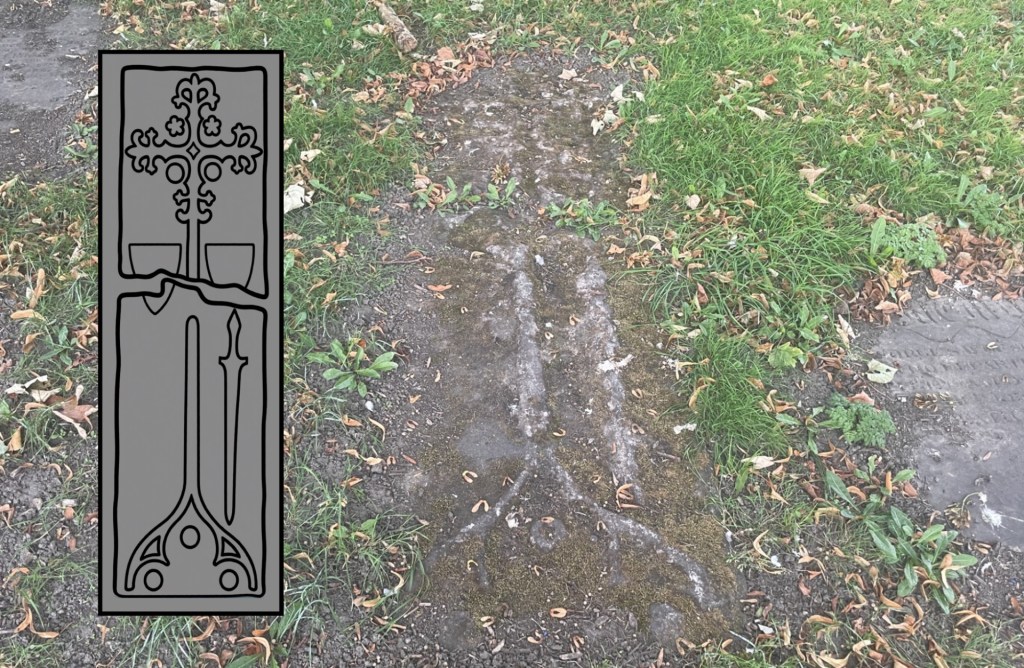
It is in the churchyard, however, that one of the more forgotten intriguing early pieces of stonework lays, being slowly eroded by nature. This stonework is a carved fifteenth century grave slab, known locally as ‘the knight’s grave’. Peter Ryder’s ‘Medieval Cross Slab Grave Covers in West Yorkshire’ is one of the few publications that really identified this monument, but not it’s true importance. The slab is carved limestone and is now broken into two pieces, sadly, and lies in the churchyard to the east end of the church, and its design is carved in high relief. Ryder interpreted the design as a cross with cusped arms and clustered fleur‑de‑lys terminals, five‑petalled flowers between the upper arms, roundels between the lower, three more roundels beneath a trefoiled ogee‑arch base, and a cross shaft flanked by shields with a sword below that on the right.
This is not a simple knight’s grave but a high status heraldic monument. The fleur‑de‑lys terminals, roses and roundels probably belong to the decorative vocabulary of the late medieval Neville and Yorkist funerary art, while the paired shields and sword almost certainly mark the deceased as a gentleman or knight entitled to bear arms. Its position at the east end of the churchyard, the most prestigious external burial zone, strongly suggests a patron or gentry burial, if it is in its original location. Wilkinson, who was aware of the slab, was adamant that it had come from inside the church based on the importance of the heraldry, and this may indeed be the case.
However, wills held in the Borthwick Institute throw this theory into doubt, in that whilst many notable residents requested to be buried inside the church, others did not. For example, a 1457 will by Thomas Sutil, the vicar of South Kirkby, explicitly requested he be buried by the great west door. A 1458 will of John Beckwith also requested he be buried in the churchyard. Only the most notable residents of the parish would have the need for such wills, in this age. It could well be that the slab belongs to such a resident as John Beckwith, but in the context of South Kirkby, where the Wentworth family dominated the parish and inherited Neville blood and heraldic quarterings, the most likely interpretation is that this slab commemorates a member of the Wentworth line or one of their cadet branches. Ryder himself dated the slab to the fifteenth century, noting that it is remarkably similar to the Richard Pickburn slab, at St. Michael’s church in Brodsworth, dated to 1421.
Richard Pickburn was a prominent local man who was well documented and therefore provides us a fairly solid dating for our own grave slab. This comparison reinforces the interpretation of the South Kirkby slab as a high status heraldic monument belonging to that time period. The motifs on the South Kirkby slab are not exclusive to the Wentworth family. As Ryder’s comparison with the Richard Pickburn slab at Brodsworth demonstrates, they belong to the wider decorative vocabulary of fifteenth century Yorkshire gentry funerary art. This regional style was shaped by the Perpendicular Gothic aesthetic and by the influence of major northern patrons such as the Nevilles and FitzHughs whose heraldic and artistic preferences filtered down into the visual culture of lesser gentry families. The cusped cross with fleur‑de‑lys terminals, the five‑petalled floral devices, the roundels and the trefoiled ogee‑arch base seen on the South Kirkby slab are all characteristic of this tradition. They appear not because Pickburn or the Wentworths were related but because both families operated within the same artistic environment and commissioned work from masons trained in the same regional idiom.
Only a small number of Wentworths were alive in this period, and most can be ruled out by known burial locations. Thomas Wentworth, who died in 1450, was buried in Doncaster while his brother Roger Wentworth, who died in 1452, was buried at Nettlestead in Suffolk, so neither can be the South Kirkby slab. A third brother, Richard Wentworth, has no recorded burial place and remains a theoretical possibility, though his date of death is unknown. The intended burial locations of many of the North Elmsall/South Kirkby Wentworth family are well documented in the Borthwick Institute wills, which show that by the early sixteenth century their preferred burial place was inside the church, specifically the Lady Chapel. Thomas Wentworth, esquire, in 1522 asked to be buried “in the north side of the ladys there, nigh where my wife lieth,” and Sir John Wentworth in the same year also chose the Lady Chapel.
However, the will of Thomas Wentworth, esquire, dated 1590, makes clear that earlier generations of the family had been buried in the churchyard. He directs that he be buried “in the churchyard near the place where my grandfather was buried.” No parish registers survive before 1620, and no Lady Chapel burial fits this description, so the only plausible candidate is an earlier Wentworth whose burial pre‑dates the sixteenth century shift into the Lady Chapel. Hunter’s South Yorkshire records a John Wentworth of North Elmsall living in 1413, the senior member of the family locally, in the early fifteenth century.
His death falls exactly within the stylistic window of the heraldic slab, and as an early fifteenth century esquire he would have been buried in the churchyard rather than the later Wentworth chapel. The 1590 will therefore preserves the memory of this earlier burial, and strongly supports the identification of the slab as the monument of John Wentworth of North Elmsall, living 1413, as per Hunter’s research. As the senior Wentworth of his generation he is the individual most likely to have been buried in the prestigious east end of the churchyard, if the slab is in its original position. Even if Wilkinson was correct, that the slab has been moved from inside the church, it could well belong to a Wentworth.
It is without any doubt that the local area has largely forgotten, or never really knew, the importance of the Wentworth family and their patronage of All Saints church, much like the nation has seemingly forgotten their national importance. The architecture shows a family so powerful and politically shrewd that they could navigate both sides of bloody wars, maintaining their local dominance no matter who wore the crown. And ultimately, they bore Kings and Queens who could trace their ancestry back to our remarkable little town, and our parish church.
 The Story of South Kirkby
What are your memories of this?